Showing posts with label town squares. Show all posts

Wednesday, October 2, 2013

Park(ing) Day Portland Maine 2013


Once a year in September in cities around the world Park(ing) Day is held to celebrate alternatives to automobile centered urban living. From the parkingday.org website: 

"PARK(ing) Day is a annual open-source global event where citizens, artists and activists collaborate to temporarily transform metered parking spaces into “PARK(ing)” spaces: temporary public places. The project began in 2005 when Rebar, a San Francisco art and design studio, converted a single metered parking space into a temporary public park in downtown San Francisco. Since 2005, PARK(ing) Day has evolved into a global movement, with organizations and individuals (operating independently of Rebar but following an established set of guidelines) creating new forms of temporary public space in urban contexts around the world.
The mission of PARK(ing) Day is to call attention to the need for more urban open space, to generate critical debate around how public space is created and allocated, and to improve the quality of urban human habitat … at least until the meter runs out!"
I designed and built an installation in a parking spot in front of the building my office is in. As our public spaces are teetering on irrelevance due to the domination of the automobile for mobility and the television and computer screens for public forums, there is certainly a need to promote urban spaces. 

My installation titled, "Piazza", creates a scaled down urban space of the sort common in medieval city centers. Buildings with no gaps between them form blocks which create streets and plazas in the space between them. My installation creates benches as blocks which are free to be moved about as they interlock to a piazza flat surface where your feet rest. This micro urban experience is a great instructional tool for children and adults who may not have lived in Venice or the Old Port.

Together we can promote these urban spaces and raise the quality of our Maine living experience and the health, community and sustainable benefits which go along with these environments.

Saturday, June 29, 2013

Outdoor Pedestrian Mall Still Car Centered

On a recent car journey we had to stop to pee and pulled over in Hingham at this strange mall. The stores were all exterior accessed like a main street. Side by side chain stores with wood siding look and wide enough sidewalks bordering a sea of parking. Everything felt like Disney World with all familiar chain stores placed as if on main street except there was no street. Not even a pseudo town green for the storefronts to look across at. Just a giant lot of parking. Hence the vastness of the distance between one very long line of storefront to the opposite side indicated processing large crowds in a way. The incongruence between the desire to imitate a pedestrian friendly main street experience and the desire to place as many cars as possible as close to everything created an uncomfortable tension for me as a lover of urban space. How was it the developers missed the boat? Cars placed behind or to the side could have allowed the space across storefront walls to contain a town common or pedestrian street. This, although still removed from the town center and a auto accessed mall, would have at least created a true "place". Note to developers: please contact me or other urban planners to help you make places people will frequent for hundreds of years and not just 10 or so. We all want the same cozy pedestrian friendly town experiences. People actually like the surprise of parking and walking, turning the corner, and coming upon a fantastic street filled with activity!
Imagine if that giant parking space with buildings around it were much smaller and green and trees and the parking was behind the buildings (very well lit with very safe feeling)?

Monday, February 11, 2013

High School in Maine Creates Spatial Experiences: 3

The endless high school hallway. It's even shown up in my dreams. At the end is doors to gym; turn left and up a few stairs and down more hallway to doors to the parking lot. Most kids in Maine grow up with this space as a dominant experience in their lives. Every weekday life's most intense moments may happen in such a space. Monotonous for the most part, hermetic and claustrophobic, moving through such a space can imprint a linear, film-like space/time memory of planning.

They're so introverted.

Such stale experience could stifle the creativity of our future planners. The double loaded corridor is always forcing it's super efficient layout on design. In the photo above, the lucky students actually get light at the end of the tunnel. Like the train tracks of the Industrial Revolution, we are forced to take only one path submissively. The same attitude led to the elevated highways crashing through our delicate pedestrian fabric and Jacobs battling Moses.

But in a true village there would be one library for everyone in town and students in all grades, and you would walk to it from a classroom building. Spatial experience would vary moving from place to place in the course of a day. Performances would take place in which ever size auditorium in the center that was the right size for the event whether it was a grade school day time event or a community night time one. This is not to say grade schools would not have their own dedicated spaces, just that buildings in town would be shared by all and not wasted, lying empty at times and built cheap because they are not important to all.

Our Maine towns should slice and dice this endless hallway by building separate buildings like a village with connected covered walkways where used often creating courtyards, town squares and landscapes for yankee pedestrian delight.

Monday, January 28, 2013

High School in Maine Creates Spatial Experiences: 2

Our concept of family, home, and place come directly from experience. If we grow up in an apartment-like place in the middle of a packed urban context then that is our comfort zone and what we consider normal. If we grow up in a small town town in a single family home then that is our normal. Experiences throughout our life add to this baseline but none can be as strong.

I lived as a teen in a house on Main Street in a small town in the middle of Maine- Orono- a college town. I couldn't imagine why anyone would want to live outside of town as I could walk across the street up to school; I could walk down to Pat's Pizza, the IGA, or LaVerdiere's (LaVerdiere's Halloween commercial) . Most of my friends could walk to school or bike if they wanted to. My concept of place is rooted in this typical small town main street space. When we got our licenses we cruised around some but of course, we spent a lot of time parked downtown and hanging out with each other leaning against our cars with the Jensen triaxials cranking out hard rock . My urban experience was main streets and the campus at UMO.

Later I fell in love with the copper roofs and burnt orange medeival fabric of the Gamla Stan in Stockholm, the brick Back Bay of Boston, the canals in Leningrad, the Moorish courtyards of the Alhambra, and the Portland Maine peninsula. These experiences compliment the main street base line by adding intricacy and spatial complexity to the pedestrian possibilities.

Our Maine spaces can improve through the strengthening of our experiences growing up here. We can focus on how our kids walk to school- what can we do to make these walks safe, fun and social? In Orono I just walked across the street and started up the short street to school. In our Maine towns we can build sidewalks and bike paths from dense housing areas to schools in town with police warming glass huts at center junctions to watch over things. My Main Street had trees along the road with sidewalks leading through town and across the bridge up towards the university. Our kids could benefit from bike paths speeding along the street and cutting through the neighborhoods.

Our families crave the coffee shop, IGA, Pat's Pizza and LaVerdiere's type stores along our Main Streets. In high school we were bored and needed places to gather and do things. We loved finding places to just hang out and look at something. This could be a view over a river or pond or a view at the town. Spatial experiences were much sought after if I think about it now, looking back. It's up to us now to help create a variegated in town spatial experience for children to move through and build enjoyable experiences. My high school Main Street life did that for me.

Thursday, May 13, 2010

Congress Square redesign

Last night the city of Portland held a meeting to gather public input regarding redesigning Congress Square. Congress Square currently is a sunken empty tar covered space filled often with vagrants. This situation is not unique to Portland and follows closely the history of Copley Square in Boston. In the sixties, Sasaki Associates won a competition to design Copley Square and responded with the trendy sunken plaza with angles and steps. Back at turn of last century, the plaza had been home to all of Boston's cultural stars such as MIT, Trinity Church, Museum of Natural History, Library, etc. Some of these institutions left and the 60's design was supposed to make this a jewel to celebrate the great location. Here's a shot of a proposal for Copley in mid 1800's:
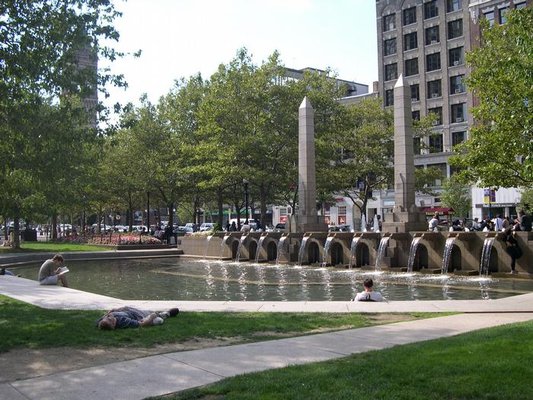
Unfortunately, the sunken plaza became a great place for vagrants and drug dealers. Sound familiar? So Boston held another competition in the early 80's to redesign Copley Square and the result is a very successful flat park with a big lawn, trees, benches, lighting and a signature fountain. 

Copley Square also hosts a farmer's market:

Portland can learn a lesson from Boston in this regard.

Proposals suggested at the workshop last night included: Andy Graham's wonderful idea of a winter garden, useable year round to be with plants; a suggestion of a major water feature and a major sculpture; a suggestion of a flat plane filled with large trees with their branches removed up to a fairly high height as seen in St. Petersburg, Russia; and to make the place nice enough that restaurants would put tables there or street vendors would set up.

All were in favor of making sure some kind of authority would care for the upkeep and cleanliness of the  space as the Portland Downtown District does for Tommy's Park.

By eliminating the sunken plaza and making a flat-like surface at level of Congress St. sidewalk and putting in plenty of trees, we can only succeed.

Thursday, January 15, 2009

Many Town Square Jewels Here


I was substitute coaching yesterday, on the bus headed west from Portland, chatting away with the other coach, both of us marveling at the view of the low mountains to our right when we went through a town center briefly. I was on the right side of the bus facing the other coach sitting on the left side . I was busy talking and focused on the subject, sensing a few buildings close together, so, a main street and suddenly- Woh!

I just saw a snow covered town square! I exclaimed my excitement and then asked the driver where we were as I had not paid attention and he said, "Cornish". Cornish?

That's right, I don't know as I've driven 25 west so not sure I've been by that square before. It's always a joy to see there are places still proudly displaying their heritage of attention to the human citizen moving on foot through the cozy space of the community.

There are many places like this in Maine and we can all learn from these living examples to move forward in our attempts to take back the way of life we know is within our grasps.